Feeling overwhelmed at work? Identify the causes, learn coping strategies, and discover how Fluidwave's AI task management can help you regain control.
October 5, 2026 (Today)
Feeling Overwhelmed at Work: A Practical Recovery Guide
Feeling overwhelmed at work? Identify the causes, learn coping strategies, and discover how Fluidwave's AI task management can help you regain control.
← Back to blog
By Friday afternoon, the warning signs are hard to miss. Your inbox is open in one tab, a project plan is half-finished in another, and three colleagues are waiting for answers in chat. You keep switching between tasks, yet the important work remains untouched. The harder you push, the less confident you feel about what deserves your attention first.
Feeling overwhelmed at work isn't a sign that you're weak, disorganized, or unsuited to responsibility. Often, it means your workload, working conditions, and available mental capacity no longer match. The practical response isn't to demand more heroics from yourself. It's to understand what overload does to your thinking, then redesign the work around that reality.
Understanding the Root Causes of Work Overwhelm
At 10 a.m., a project manager may be answering a client question, revising a schedule, and approving a hiring request while a strategic deliverable waits untouched. By lunch, the open tabs have multiplied, but the work requiring sustained judgment has barely moved. The problem is not merely a crowded calendar. Each interruption asks the brain to reload context before it can make the next decision.
That pattern points to a workload mismatch, not a character flaw. Working memory can hold only a limited amount of information at once. Switching between unrelated tasks, remembering incomplete commitments, and tracking changing priorities consume that capacity before the main work begins. Stress and fatigue reduce the capacity available for reasoning, so adding effort can produce more activity without producing better progress.
The scale of the problem is visible in workplace research. An analysis cited by MIT Sloan Review found that 35% of employed Americans agreed or strongly agreed that they had too much work to do well in their jobs, compared with 27% in both 2002 and 2006. The same source reported that professionals and managers in a Fortune 500 IT division often lacked enough time to complete their work, as described in this workplace mental health analysis.

Busyness isn't the same as useful progress
A busy day can still support progress when the outcome is clear, the sequence is manageable, and focused time is protected. Structural overload has a different shape. Priorities compete, deadlines move, meetings break concentration, and new requests arrive without an explicit decision about what should wait.
The cost appears in the transitions. Moving from a budget review to a customer escalation, then to a hiring question, forces the brain to discard and rebuild context repeatedly. A task list may look reasonable as a collection of separate items, while the switching between them creates the true burden. Telling people to manage time better does little when the work system keeps creating new decisions every hour.
Treat overwhelm as operational information. Identify commitments that require your attention, decisions arriving without an owner, and recurring work that can be assigned through a shared task board, intake form, or automated workflow. Delegation tools do not remove accountability. They move repeatable work and defined decisions to the person best placed to handle them, preserving working-memory capacity for judgment-heavy tasks.
Teams can also review practical burnout prevention methods alongside a grounded guide to mental health at work. The aim is structural: reduce unnecessary switching, make ownership visible, and give people fewer competing demands to hold in mind at once.
Signs Your Workload Is Outpacing Your Capacity
You finish a meeting, open a message, and forget why you were there. A short approval sits untouched while you tackle a harder assignment. You still attend meetings and answer messages, yet the quality of your thinking has shifted. Overwhelm often appears as slower judgment, repeated checking, task avoidance, or difficulty explaining what is wrong.
The issue is more specific than feeling busy. Cognitive overload occurs when the combined demands of tasks and the work environment exceed working-memory capacity. Working memory can hold only a limited amount of information while you reason and decide. Fatigue, stress, and constant multitasking increase reliance on mental shortcuts rather than careful decisions, which can raise errors and reduce decision quality, as explained by McKinsey's analysis of cognitive overload.
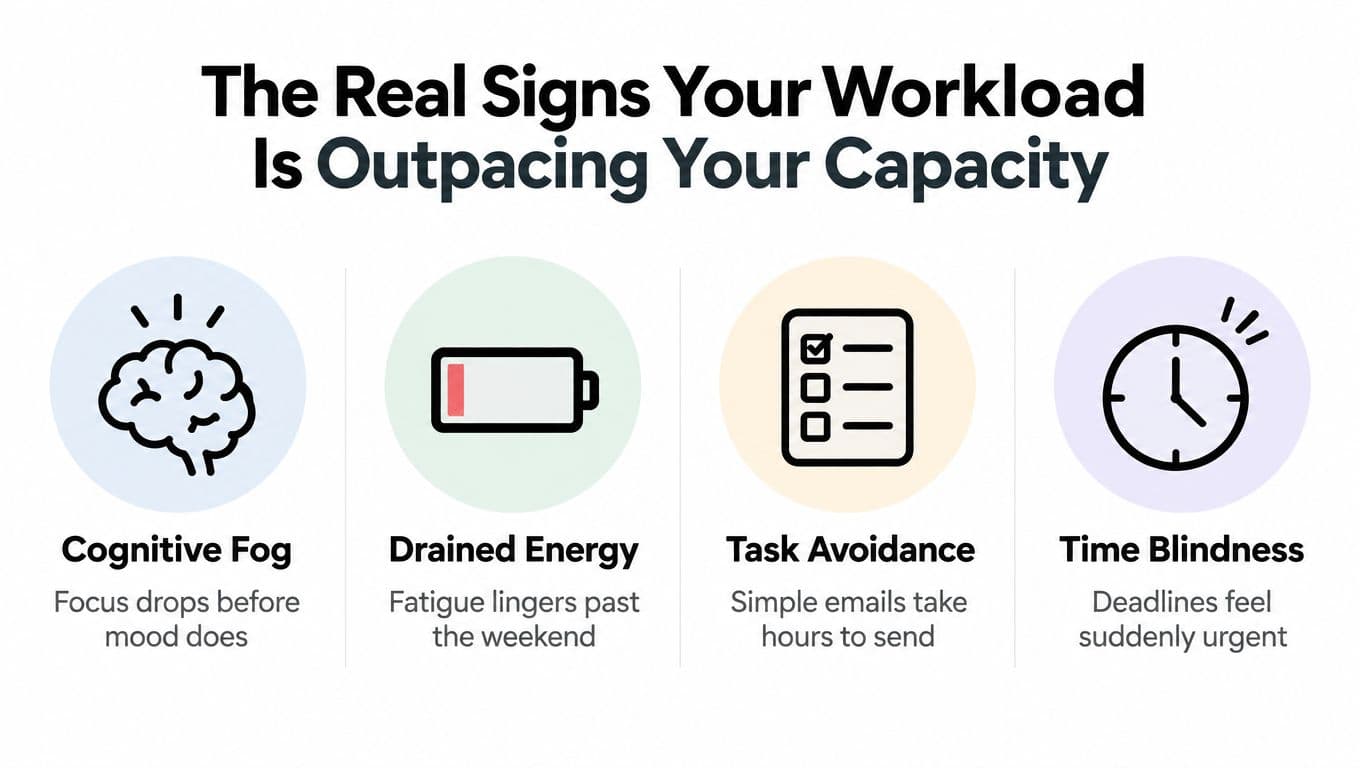
Four signals worth taking seriously
- Cognitive fog: You reread a short message several times, lose the thread of a discussion, or struggle to choose between options that normally feel straightforward.
- Drained energy: Rest no longer restores you fully. Fatigue follows you beyond the workday and makes routine decisions feel disproportionately expensive.
- Task avoidance: You postpone a small email, approval, or form because starting feels harder than handling a complex task. This is not always laziness. Initiation and prioritization may be under strain.
- Time blindness: A task expands unexpectedly, or a deadline seems distant until it becomes an emergency. Interruptions break the original estimate, leaving you with no reliable sense of how long the work will take.
The scale of the problem is substantial. A 2025 workplace stress report covering more than 16,000 professionals across 11 major markets found that 45% were too busy to deliver meaningful results, 61% were handling the responsibilities of more than one job, and 49% of managers were exhausted, according to coverage of the report.
The same article reports findings from an Australian survey of 1,642 workers. 59% experienced mental distress from work overload, rising to 62% in professional services. Keeping these findings separate makes the pattern clearer: overload affects both output and the person carrying the work.
Stress, burnout, and overload aren't interchangeable
Stress can follow a demanding period and ease when the demand ends. Burnout involves a more persistent decline in energy, motivation, and effectiveness. Cognitive overload describes what happens to information processing when volume and switching exceed available capacity.
These states can overlap, but they call for different responses. A walk may help regulate you in the moment, yet it will not fix five recurring meetings with no decisions, an unclear role, or a project portfolio with more commitments than the team can deliver. Track the first point at which your thinking deteriorates. That evidence can show whether the remedy belongs in recovery, workload allocation, or the design of the work itself.
Why Hustle Culture Is Failing You Right Now
Working longer can feel like the only responsible option. There is always another message to answer, another revision to make, or another late meeting to attend. The problem is that extra hours don't automatically create extra capacity. They can just extend the period in which tired judgment produces work that must later be corrected.
Gallup reports that burnout risk rises as weekly hours increase, but workload experience matters more than hours alone. Its research also finds that engaged employees working 45 or more hours per week are far less likely to burn out than employees who aren't engaged or are actively disengaged while working the same hours, as documented in Gallup's guidance on preventing burnout.
The false bargain of extra effort
Hustle culture makes a simple promise: sacrifice recovery now and you'll regain control later. That bargain breaks down when the work itself is poorly structured. If each day brings the same interruptions, unclear priorities, and excessive approval loops, longer hours don't remove the source of demand. They reduce the time available to recover from it.
The more useful question isn't “How can I fit everything in?” It's “Which work deserves my best cognitive capacity?” A strategic decision made early in the day may prevent hours of rework. A clear refusal may protect a delivery date more effectively than another evening spent trying to satisfy every request.
Practical rule: Treat attention as a constrained project resource, not as an unlimited personal virtue.
Busy also doesn't mean important. A full calendar can conceal low-value activity, while a quiet block spent resolving a core dependency can move an entire project forward. In deadline chaos, I've found that teams regain momentum when leaders make trade-offs visible. They name what will be delayed, who owns the decision, and what outcome takes priority.
Willpower has a role, but it can't compensate for a workflow that continually exceeds working-memory capacity. Sustainable performance comes from reducing unnecessary decisions, protecting focused work, and giving people permission to stop treating exhaustion as proof of commitment.
How to Prioritize Tasks When Everything Feels Urgent
When every task appears urgent, don't begin by trying to complete the list. Begin by separating consequence from noise. The Eisenhower Matrix is useful because it forces a decision about impact instead of allowing the loudest request to control the day.
Take every open task and place it into one of four categories:
- Important and urgent: Handle these first. They affect a live deadline, a serious client commitment, a blocked dependency, or a material business risk. Define the next physical action, not a vague label such as “fix launch.”
- Important but not urgent: Schedule protected time for these. Strategic planning, process improvement, hiring, and quality work often land here. If you don't assign time, urgent work will consume the space.
- Urgent but not important: Delegate, automate, batch, or reduce these. A request may be loud because someone wants a fast answer, not because it creates meaningful value.
- Neither important nor urgent: Delete, archive, or challenge these. Keeping low-value tasks visible can create the illusion that your workload is larger and more unavoidable than it is.
A practical triage sequence
Write down everything competing for attention. Don't trust the list in your head, because memory keeps resurfacing unfinished items and makes each one feel equally pressing.
Next, ask three questions:
- What happens if this waits? Describe the actual consequence, not the feeling attached to the task.
- Who is the right owner? A task that only you can approve is different from a task that only happens to have reached you.
- What outcome does this support? If you can't connect the task to a current objective, question its place on today's list.
Choose one important and urgent item, then define a short working block for it. Send a message to reset expectations on the rest. A transparent delay is usually safer than silent overcommitment, because stakeholders can make informed trade-offs when they know the constraint.
For a more structured way to sort work by urgency and impact, use this guide to prioritizing tasks at work. The tool matters less than the behavior it creates: fewer simultaneous commitments, clearer ownership, and a visible reason for saying “not yet.”
Using Delegation to Regain Control of Your Time
Delegation is often treated as a management skill, but its first benefit is cognitive. When another capable person handles scheduling, inbox sorting, research, data entry, or routine follow-up, your brain no longer has to keep those open loops active while you work on a complex decision.
That doesn't mean handing away anything inconvenient. Effective delegation starts with separating unique contribution from repetitive execution. Your judgment, client relationship, or final approval may be difficult to replace. Booking the meeting, collecting background information, formatting the document, and checking for missing details may not require your personal attention.

Delegate with enough context to succeed
Poor delegation creates rework. A vague instruction such as “take care of this” transfers anxiety without transferring clarity. Give the person the outcome, constraints, source material, deadline, and definition of done. Then specify when you want an update, rather than interrupting them repeatedly for reassurance.
A simple delegation brief can contain:
- Outcome: What should exist when the task is complete?
- Boundaries: What can the person decide without asking?
- Inputs: Which files, accounts, examples, or contacts are available?
- Escalation point: What issue requires your judgment?
- Handoff format: Where should the finished work appear?
Teams also need visible ownership. If you're improving the way work moves through a group, guidance on how to build accountability into your team can help distinguish support from micromanagement. Accountability means the owner knows the expected result and the manager can see progress without taking the task back.
For professionals who don't have an assistant available, Fluidwave combines AI-driven task management with a network of human virtual assistants. It supports delegation to skilled assistants on a pay-per-task basis, so a busy professional can offload defined work without adding another permanent role. The platform can also support workflow organization and task visibility, which makes delegation easier to manage than sending a request into an untracked chat thread.
Start with one recurring category. Delegate the preparation for a weekly report, the first pass of inbox sorting, or the research needed for a decision. Review the output, improve the brief, and expand only when the handoff is reliable. More detail on the mechanics is available in this guide to how to delegate.
Building a Sustainable Workflow System for the Long Term
A clear inbox can still produce an overloaded brain. Working memory holds only a limited number of active commitments, decisions, and interruptions at once. When requests remain scattered across email, chat, meetings, and notes, your brain keeps rebuilding the same context. A sustainable workflow reduces that load through visible rules and reliable handoffs.
A practical system has four movements: capture, prioritize, batch, and review.
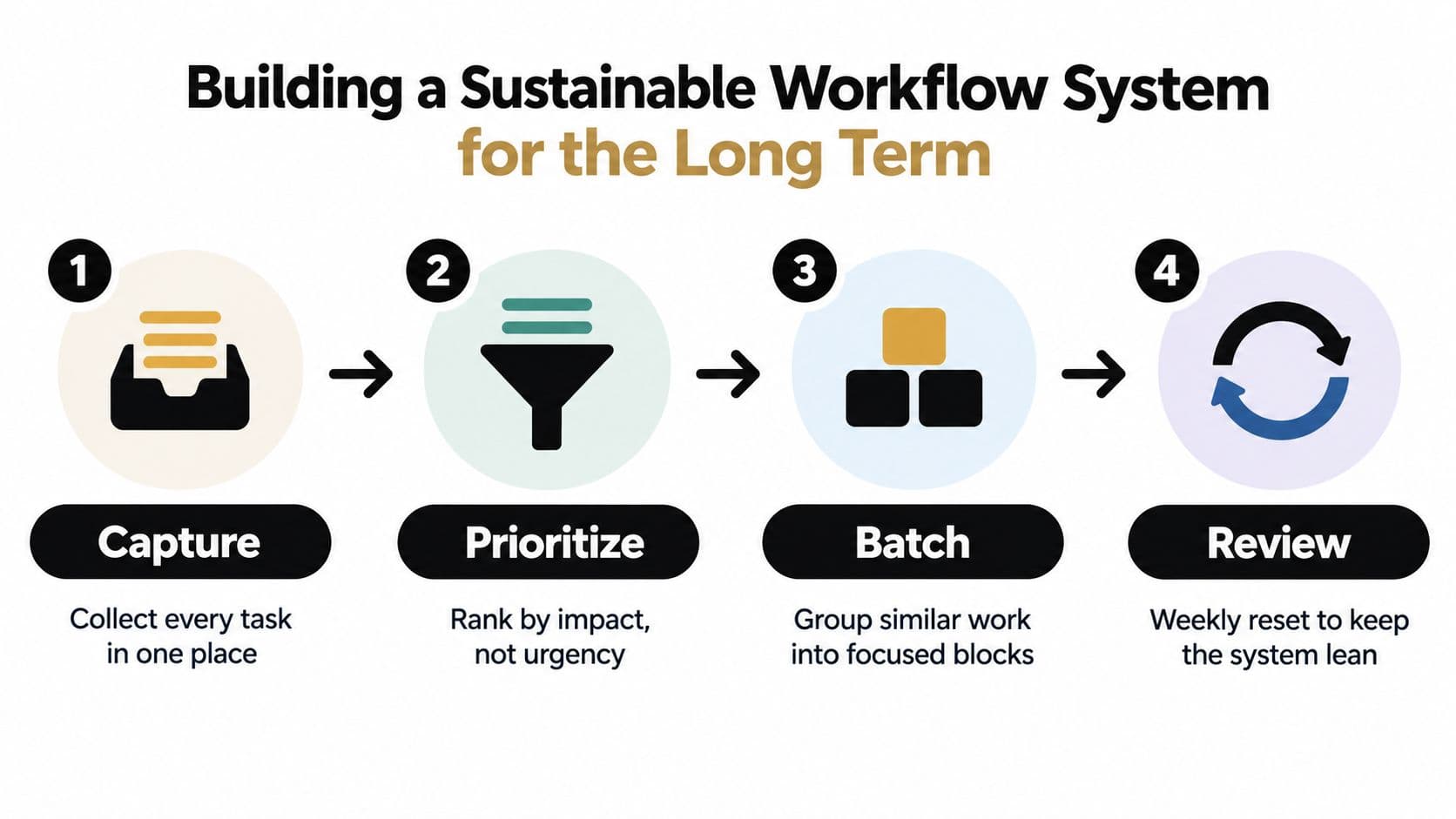
Capture every commitment
Use one trusted task inbox for requests, follow-ups, ideas, and decisions. Work can still arrive through email, chat, meeting notes, or personal reminders, but those channels should not become separate task systems. During a daily reset, transfer each commitment into the trusted list and record its next action.
The point is to remove open loops from working memory, not to create another place to check.
Prioritize by consequence
Compare the list with current objectives, deadlines, and available capacity. Identify what requires your judgment, what another person can own, and what should be declined or deferred. A priority matters only if it changes your next action, so keep the active list short enough to guide behavior.
When every request appears urgent, check the consequence of delay and the cost of interruption. Protect work that requires sustained concentration before lower-value requests consume the day.
Batch similar work
Group approvals, messages, research, and administrative tasks into defined periods. Batching protects concentration by reducing the number of context switches. It does not mean ignoring genuine emergencies. Place focused tasks on the calendar before meetings occupy the remaining space.
Review the machine
A weekly review should examine where work entered, where it stalled, and why. Look for repeated blockers, unclear ownership, unnecessary meetings, and tasks that return because nobody has defined completion. Change the workflow or the handoff instead of asking for more personal endurance.
A sustainable workflow makes the right action easier to see before pressure makes every action look equally urgent.
Overload is a work-design problem as well as an individual experience. Earlier analysis found that the share of employed Americans reporting too much work to do well increased from 27% in 2002 and 2006 to 35% in the later analysis, as described in this overview of workplace overload. The practical response is to change how teams assign, sequence, and inspect work, rather than expecting people to absorb unlimited demand.
Use the system for two weeks, then inspect the first failure mode: commitments that were captured but never given an owner or next action. Correct that rule before adding more tools. If overwhelm continues to affect sleep, health, relationships, or your ability to function, involve a qualified mental health professional while addressing the work design.
You do not need to become better at tolerating a broken workflow. You need a dependable way to see commitments, protect cognitive capacity, and move suitable work to someone else. Delegation tools can support that structure by making ownership and task status visible.
Fluidwave combines AI task management, multiple work views, workflow organization, and access to human virtual assistants for delegated tasks. If scattered requests and low-value administration are driving the overload, visit Fluidwave to organize defined work and begin offloading it.
Focus on What Matters.
Experience lightning-fast task management with AI-powered workflows. Our automation helps busy professionals save 4+ hours weekly.