Try 10 practical team meeting activities with timings, objectives, facilitation tips, templates, and Fluidwave follow-up ideas.
October 4, 2026 (1d ago)
10 Team Meeting Activities That Drive Results
Try 10 practical team meeting activities with timings, objectives, facilitation tips, templates, and Fluidwave follow-up ideas.
← Back to blog
A familiar meeting ends with everyone nodding, yet nobody can explain what happens next. One person thinks the launch is approved, another expects more research, and a third leaves with an action that has no owner or deadline. The conversation felt productive, but the team's shared understanding is still fragile.
That pattern is expensive. A typical employee spends 392 hours per year in meetings, more than 16 full workdays, according to Flowtrace's meetings research. Another benchmark places weekly meeting time at 11.3 hours, or about 28% of a 40-hour workweek, while 67% of meetings are considered unproductive in the same research ecosystem. The answer isn't to remove every meeting. It's to make each one fit the work.
The best team meeting activities match the immediate purpose, protect the timebox, include quieter participants, and end with visible ownership. Use the formats below as ready-to-run patterns. Each one gives you an ideal duration, a practical objective, facilitation steps, a simple template, and a way to turn the outcome into assigned Fluidwave tasks.
1. Stand-up Meetings
Stand-ups work when the team needs fast coordination, not a project review. A software team preparing a release, for example, can use a short daily check-in to surface a blocked test without forcing everyone into a deep technical discussion.
Keep the format predictable: each person shares what they completed, what they're doing next, and where they're blocked. A 15 to 30-minute timebox is enough for most small teams, especially when updates are prepared in advance.
Run the update, then move the blocker
Ask each participant to use this template:
- Yesterday: What did I complete?
- Today: What will I work on next?
- Blockers: What needs another person's help?
The facilitator should interrupt politely when a topic becomes a solution discussion. Capture it, name the people needed, and schedule a separate conversation. Standing in person can naturally keep the meeting brief. Remote teams can use video for connection while still accepting written updates when time zones or focus needs make an async response more appropriate.
Practical rule: A stand-up should expose coordination problems, not solve every problem in the room.
Pull task status into the discussion rather than relying on memory. In Fluidwave, create a task for each blocker, assign the person responsible for removing it, and add a due date for the next check-in. Close the task only when the blocker is fully resolved, not when someone says they'll investigate it.
2. Brainstorming Sessions
A marketing team can waste a meeting debating the first campaign idea before anyone has explored better options. Brainstorming works best when the group knows which problem the ideas must address and postpones evaluation until people have contributed independently.
Open with a focused question, such as, “How might we reduce customer confusion during onboarding?” Name the target user, key constraint, and desired outcome. Give participants a few silent minutes to write before discussion begins. This gives quieter contributors room to think and prevents the first suggestion from setting the direction.
Create first, evaluate later
Use a 20 to 30-minute session for idea generation, then schedule a separate review. Set up a shared document or whiteboard so remote participants can contribute equally. Invite people to build on suggestions with “Yes, and” additions, while recording criticism for the evaluation stage. Group similar ideas by theme, but avoid ranking them before the full set is visible.
Keep the facilitation sequence simple: define the question, collect ideas independently, expand promising suggestions, and cluster related concepts. The trade-off is clear. Separating judgment produces a wider range of options, but it requires a later meeting or owner to test them.
Close by naming who will evaluate the themes and when that decision will happen. In Fluidwave, create a task for each promising concept and assign an owner to refine it, document assumptions, or gather evidence. Include the evaluation date in each task. The meeting creates value only when every viable idea has a visible next action.
3. Retrospectives and Demo Reviews
A combined retrospective and demo works when the team needs to inspect both its process and its output. Keep the purposes separate: the demo shows what changed, while the retrospective examines how the work happened.
Start with the previous retrospective's action items. Mark each as completed, overdue, or abandoned, then ask whether the result supports the next cycle. This creates a clear connection between past discussion and current work.
Run the review within a 60-minute maximum. A practical sequence is:
- Open with progress: Recognize completed improvements and useful outcomes.
- Show the work: Demonstrate the user journey, not a feature list. A product team might walk through a new checkout flow using a realistic customer scenario.
- Collect feedback: Record observations separately from decisions so suggestions do not become commitments by accident.
- Reflect on delivery: Use Start, Stop, Continue to identify behaviors worth changing, preserving, or testing.
- Confirm ownership: Decide which improvements belong in the next work cycle.
Reserve 20 minutes for the demo and 10 minutes for feedback, leaving time for the action review and retrospective. Prepare the demo in advance, and collect anonymous input beforehand if quieter participants may hesitate to raise concerns publicly.
Use a sample meeting notes format to record context, decisions, and ownership while the discussion is fresh. Turn every accepted improvement into a Fluidwave task with an owner, due date, and connection to the next work cycle. If feedback needs investigation rather than an immediate decision, assign that investigation separately.
The following walkthrough can help facilitators visualize the process.
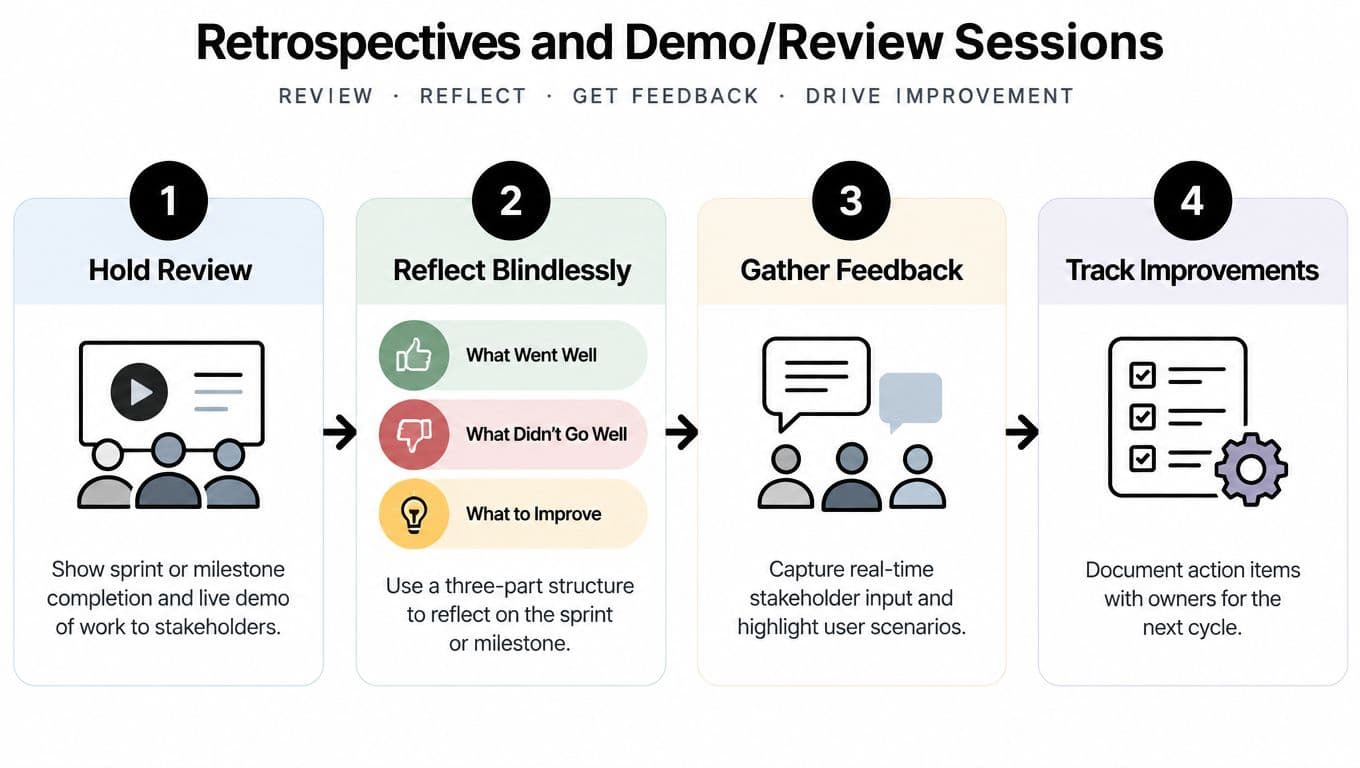
For teams that learn well from examples, this video offers another way to frame a retrospective and review conversation.
4. One-on-One Meetings
A missed deadline may reflect unclear priorities rather than poor performance. A one-on-one gives the manager and employee room to find that distinction, discuss growth privately, and address concerns that do not belong in a group meeting.
Give the employee control of the agenda. Send a shared template before the meeting with prompts for wins, challenges, goals, development, and personal connection. The manager should listen, ask focused questions, and remove obstacles instead of filling every pause with advice.
A weekly or bi-weekly rhythm gives both people time to prepare, but the conversation should respond to current needs. An employee may need help with an unclear handoff, feedback on a leadership opportunity, or an honest discussion about workload. Address those topics before routine status updates.
Run the meeting in four moves: Start with the employee's agenda by asking what matters most today. Explore before solving by clarifying the situation and its impact. Discuss development by connecting current work to a longer-term capability. Confirm support by agreeing on what the manager will do next.
Keep the format flexible. A short check-in may be enough after a stable week, while a workload or development conversation needs more time. If every meeting focuses on deadlines, relationship and growth work will disappear.
Share notes afterward, limited to useful context, decisions, and commitments. If the employee needs a cross-team introduction, a document, or a decision, create a Fluidwave task with the responsible person and due date. Keep sensitive personal details out of broad team boards, while recording the practical follow-up where the owner can act on it. At the next one-on-one, review those tasks first and close, update, or reassign each one.
5. Working Sessions
A design and engineering team shaping a new dashboard should leave with more than shared opinions. In a focused working session, they can sketch the layout, identify technical constraints, and agree on the next prototype. The meeting earns its place by producing a usable result during the scheduled time.
Write that result in the invitation. For example: “By the end, we'll produce the first version of the onboarding flow and identify unresolved questions.” Participants know what to prepare, and the facilitator has a clear standard for ending the session.
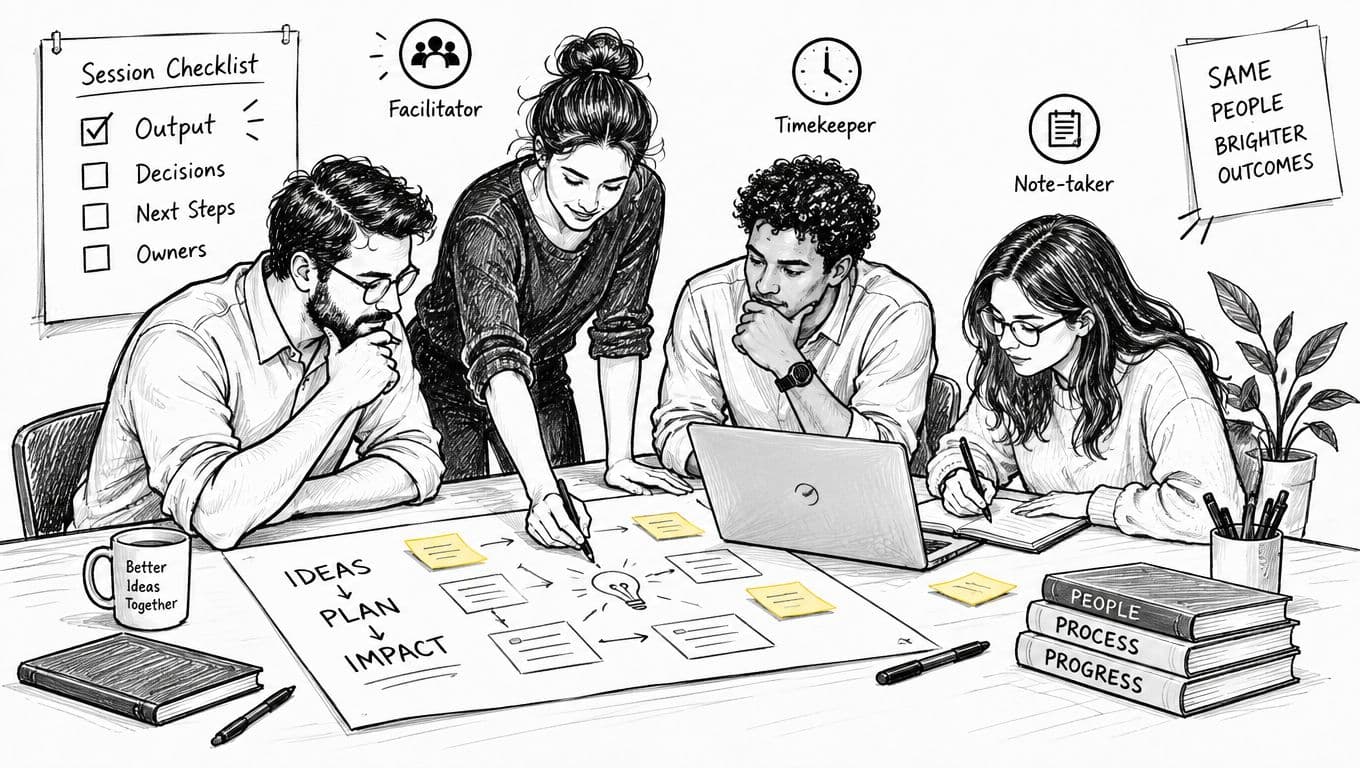
Before the meeting, ask attendees to read the source material, collect relevant data, or bring initial ideas. Open the working document as the meeting begins, then assign a facilitator, note-taker, and timekeeper. Keeping the document visible lets participants see decisions and revisions as they happen.
Build the session around five conditions: A defined result sets the meaning of done for today. Prepared inputs prevent the group from spending its first half on basic context. Decision authority ensures someone present can approve the output or has delegated authority. Timeboxed blocks give each discussion a start and stopping point. A closing recap confirms decisions, open questions, and owners.
The format can change with the work. Use a short sequence of review, creation, constraint check, and approval for a concrete design task. For a less defined problem, reserve more time for idea generation before narrowing the options. The trade-off is clear: tighter structure produces faster output, while a looser format gives participants more room to explore.
Create Fluidwave tasks before the document is closed. Assign the prototype, research, review, or dependency to a named person, add a due date, and include a brief decision summary. Someone who missed the meeting should understand the rationale without replaying the conversation. Review those tasks in the next working session and close, update, or reassign each one.
6. All-Hands Meetings
A company-wide launch can leave employees with two very different impressions: they understand the strategy, or they hear a polished presentation and still do not know what changes for them. All-hands meetings work best when people need a shared view of strategy, performance, major decisions, and culture.
Explain why, not only what. If leadership announces a new customer segment, connect the decision to the business reason, the alternatives considered, and the effect on product, sales, support, and operations. That context helps each team interpret the update without guessing.
Keep the agenda short enough to hold attention. A practical sequence might combine a strategy update, specific employee recognition, a team spotlight, and live questions. Seed questions only when needed, and label them clearly rather than presenting prepared prompts as employee concerns.
Participation also depends on the setup. Accept spoken, written, and anonymous questions. Test audio, video, captions, and recording access before the session. Give remote attendees an equal route into the discussion by assigning a moderator to monitor chat and bring questions forward. Recognition should name the contribution and its effect, while each company priority should be translated into team-level work.
Close with a written decision and action recap. The all-employee meeting guide can help leaders choose the format and plan follow-up. In Fluidwave, create a task for every priority that affects a team or project, link it to the relevant update, assign an owner, and set the first delivery point. Review those tasks at the next team check-in so the meeting produces visible work rather than a one-time announcement.
7. Planning and Estimation Meetings
A launch plan can look achievable until the team checks its workload. The landing page may depend on legal review and product screenshots, while support duties and planned absences reduce delivery capacity. A good planning meeting exposes those constraints early, then turns priorities into work the team can realistically support.
Prepare before people join. Groom the backlog, clarify acceptance criteria, and record known dependencies so the meeting focuses on choices rather than first-time explanations. Start by reviewing available capacity and the outcomes that matter most. Then estimate the highest-priority work with relative measures such as story points. Relative estimation compares effort without creating false confidence that every task can be forecast accurately in hours.
Use planning poker when the team's estimates differ. Ask each person to explain the assumption behind their estimate, especially when one person sees a feature as small and another sees it as large. The discussion can reveal unclear requirements, hidden technical work, or missing reviews. Keep the item in discussion until the team understands the uncertainty, then record the agreed estimate.
Work through the backlog in priority order. Map dependencies as they appear, break oversized items into smaller deliverables, and leave capacity for unexpected work. At the close, name the work the team accepts, record what was deferred and why, and confirm the next delivery point.
Update each Fluidwave task during the meeting. Add the context, acceptance criteria, dependencies, and definition of completion, then assign an owner. In the next retrospective, compare estimates with actual delivery. Adjust the shared estimation method based on what the team learned, rather than treating variance as an individual failure.
8. Decision-Making Meetings
A product choice stalls when nobody knows who can approve it. Set the meeting's finish line before inviting people: a decision, a named decision-maker, or a documented reason to gather more information.
Send a brief in advance covering the problem, constraints, available options, recommendation, and missing information. Collect opinions before the meeting where possible. Reserve meeting time for testing assumptions, weighing trade-offs, and committing to one option. This keeps the discussion from repeating background explanations.
Make the decision easy to act on
Use a RACI model to identify who is responsible, accountable, consulted, and informed. The accountable person should bring two or three viable options, with the advantages and drawbacks of each. For a major platform choice, run a pre-mortem: ask what would have gone wrong if the selected option had failed. Give the group a defined period to challenge the options, then ask the accountable person to decide.
Record the outcome in plain language:
- What was decided: State the choice clearly.
- Why it was chosen: Capture the reasoning that settled the question.
- Alternatives considered: Explain why they were rejected.
- Revisit point: Set a time to review the result.
- Immediate actions: Assign the implementation work.
Consider reversibility when setting the pace. An easily reversed choice can move faster than one that creates lasting commitments. Both require an owner and a check on results.
Before closing, create the implementation tasks in Fluidwave. Separate communication, delivery, and validation tasks when different people own them, assign due dates, and link each task to the decision record. For a significant choice, schedule the follow-up review and connect it to the original task. Future discussions can then start with the recorded reasoning and evidence instead of reopening the same question.
9. Team Building and Social Meetings
Connection meetings support trust, recognition, and belonging, but forced fun can weaken all three. Choose an activity that suits the team's culture, energy, accessibility needs, and working setup. Make participation optional, then explain the purpose before anyone joins.
A remote team could hold a low-pressure coffee conversation, shared show-and-tell, or asynchronous celebration thread. An in-person group might pair recognition with informal conversation. The activity matters less than whether people can participate without performing enthusiasm.
Use a simple format: state the purpose, explain the activity, offer individual and group participation options, then close with a brief reflection. The facilitator should watch for quieter contributors and make it easy to pass. A lively game can work for one group, while another may prefer paired conversation, chat responses, or observation.
Purpose might be to celebrate a launch, welcome a colleague, or strengthen connection. Real choice means declining carries no hidden attendance penalty. Different participation modes can include speaking, chat, paired discussion, or watching. Specific recognition should name the work and the people who made it possible. A light recap can preserve useful context without turning social time into paperwork.
For offsite planning, these team building activities for offsites offer starting points, but adapt each option to your team's needs. Use these team-building activity ideas to compare formats, then check time zones, cultural differences, dietary restrictions, mobility, and sensory needs before choosing.
End by asking what anyone has promised to do. Turn each commitment into a Fluidwave task with a named owner and due date, such as sending photos, ordering materials, welcoming a colleague, or organizing the next celebration. Keep the recap light, but give every practical follow-up a clear destination.
10. Cross-Functional Collaboration Meetings
A launch can stall when product, security, marketing, and operations each protect a different requirement. Cross-functional collaboration meetings expose those constraints while the team can still adjust the plan. Begin with the shared customer problem and intended outcome, then ask each function to name its priorities, risks, and definition of success.
Give the facilitator authority to balance airtime and test assumptions. A neutral lead can keep the discussion from being controlled by the function with the strongest vested interest.
Design the handoffs before assigning the work
Use a RACI model to clarify decision rights before debate begins. Then trace the work between functions. For a product launch, identify who owns positioning, who approves claims, who supplies product details, and what must be ready before sales enablement begins.
Run the meeting as a working sequence:
- Set context: State the shared outcome and customer problem.
- Surface constraints: Record what each function cannot compromise.
- Find integrated options: Compare solutions against those constraints.
- Define success: Agree on the measures and evidence that matter.
- Set handoffs: Name owners and acceptance conditions.
Capture the decisions as they happen. A shared Fluidwave board can assign each cross-functional task to an owner, add a due date, show dependencies, and record handoff criteria. Add the reasoning behind important decisions so teams do not reinterpret the outcome after returning to their departments. Use shared team calendar tips to coordinate recurring sessions without sending unnecessary invitations.
For longer initiatives, schedule a process retrospective after a meaningful milestone. Review communication, handoffs, and decision rights alongside the deliverable. Convert each agreed improvement into a Fluidwave task with one owner, a due date, and a short completion note.
Comparison of 10 Team Meeting Activities
| Meeting Type | 🔄 Implementation Complexity | ⚡ Resource Requirements | 📊 Expected Outcomes | 💡 Ideal Use Cases | ⭐ Key Advantages |
|---|---|---|---|---|---|
| Stand-up Meetings | Low, time‑boxed routine, needs discipline | Minimal, team members, brief sync tool | Daily progress visibility; early blocker detection | Daily sprint teams; distributed teams | Quick alignment; accountability; reduces status emails ⭐⭐⭐ |
| Brainstorming Sessions | Medium, needs facilitation and structure | Moderate, diverse participants, ideation tools | Large volume of ideas; creative direction | Early concepting; product features; marketing ideas | Generates novel options; builds psychological safety ⭐⭐⭐ |
| Retrospectives & Demo/Review Sessions | Medium, structured facilitation required | Moderate, stakeholders, demo‑ready work, feedback channels | Actionable improvements; stakeholder alignment; lessons learned | Sprint end, milestones, incident reviews | Continuous improvement; visibility of work; reduces rework ⭐⭐⭐ |
| One‑on‑One Meetings | Low, recurring private sessions | Moderate, manager time per direct report | Personalized feedback; career development; early issues | Coaching, performance check‑ins, remote teams | Builds trust; improves retention; uncovers burnout ⭐⭐⭐ |
| Working Sessions | Medium‑High, prep and clear roles needed | Moderate, small focused group, collaboration tools | Tangible deliverables; real‑time decisions | Design sprints, complex problem solving, drafts | Rapid output; faster decisions; high engagement ⭐⭐⭐ |
| All‑Hands Meetings | High, large coordination and production | High, leadership time, AV, logistics | Company alignment; strategic updates; morale boost | Company-wide announcements, quarterly reviews | Builds culture and transparency at scale ⭐⭐ |
| Planning & Estimation Meetings | Medium, requires pre‑grooming and discipline | Moderate, product, engineering, planning tools | Realistic timelines; sprint commitments; capacity plan | Sprint planning, roadmap sequencing | Consensus on scope; reduces scope creep ⭐⭐⭐ |
| Decision‑Making Meetings | Medium, clear process and decision owner needed | Moderate, stakeholders, data, prework | Documented decision with rationale and next steps | Roadmap choices, architecture, hiring, investments | Removes ambiguity; creates accountability ⭐⭐⭐ |
| Team Building & Social Meetings | Low, simple planning; sensitive to culture | Low‑Moderate, budget, facilitation, inclusive activities | Stronger relationships; improved morale and belonging | Onboarding, remote inclusion, milestone celebrations | Boosts engagement and retention; fosters belonging ⭐⭐ |
| Cross‑functional Collaboration Meetings | High, scheduling + strong facilitation required | High, reps from 3+ functions, leadership involvement | Aligned multi‑team plans; reduced handoff errors | Product launches, go‑to‑market, architecture reviews | Prevents silos; shared ownership; fewer reworks ⭐⭐⭐ |
Turn Good Conversations Into Visible Progress
The right team meeting activity depends on the work in front of you. Use a stand-up when people need quick coordination, a brainstorming session when the question is still open, a working session when the team must create something together, and a decision meeting when the group has enough information to choose a path. Don't use an all-hands meeting to solve a problem that belongs to four people, and don't turn a one-on-one into a public status report.
Meeting design matters because meeting load is already substantial. One 2026 industry summary reports that knowledge workers spend about 15 to 17 hours per week in meetings, while managers and executives can spend roughly 60% of their week there, according to MeetingToll's meeting waste summary. That doesn't mean every meeting should be shorter. A CIPD evidence review found that meeting too often can harm effectiveness, satisfaction, and wellbeing, while meeting duration itself showed no negative impact on effectiveness in the reviewed evidence. Cadence deserves as much attention as length.
Use a simple implementation routine before every recurring meeting:
- Define the outcome: Write what participants must understand, create, decide, or improve.
- Set the duration: Choose a timebox that fits the outcome, not the default calendar slot.
- Assign facilitation roles: Name the facilitator, note-taker, and timekeeper when the meeting needs them.
- Capture decisions: Record the decision, rationale, unresolved questions, and next review point.
- Create visible work: Turn every follow-up into a named Fluidwave task with an owner and due date.
A meeting-to-outcome ratio can be more useful than attendance or enthusiasm. The emerging hybrid-team benchmark described in the meeting load research from Ghent University%20Unpacking%20the%20meeting%20load%20paradox-%20Impacts%20on%20engagement%20and%20burnout%20across%20work%20arrangements.pdf) frames 70% or more as a healthy level for high-performing hybrid teams. Treat that as a directional benchmark, not a universal target. The useful question is whether meetings consistently produce documented outcomes, action items, or a clear end date.
Burnout adds another reason to choose carefully. The same research finds that meeting load is positively related to burnout overall, while its relationship with engagement varies by work arrangement. Remote-only work shows higher burnout in the findings, whereas in-person-only work shows lower engagement, so merely adding interaction won't solve the underlying problem. Teams need the right amount of contact, with enough focus time left to do the work.
End each meeting by reading the action list aloud. Ask each owner to confirm the task, deadline, and expected result. At the next meeting, review what was completed before opening a new discussion. If the format produces little progress, change the activity, reduce the cadence, or remove the meeting. A recurring invitation is not evidence that the meeting still deserves its place.
Fluidwave helps teams turn meeting notes, decisions, and action items into assigned work with owners and due dates. Create shared task views, track follow-through across projects, and visit Fluidwave to move your next meeting from discussion to visible progress.
Focus on What Matters.
Experience lightning-fast task management with AI-powered workflows. Our automation helps busy professionals save 4+ hours weekly.